Copywriting
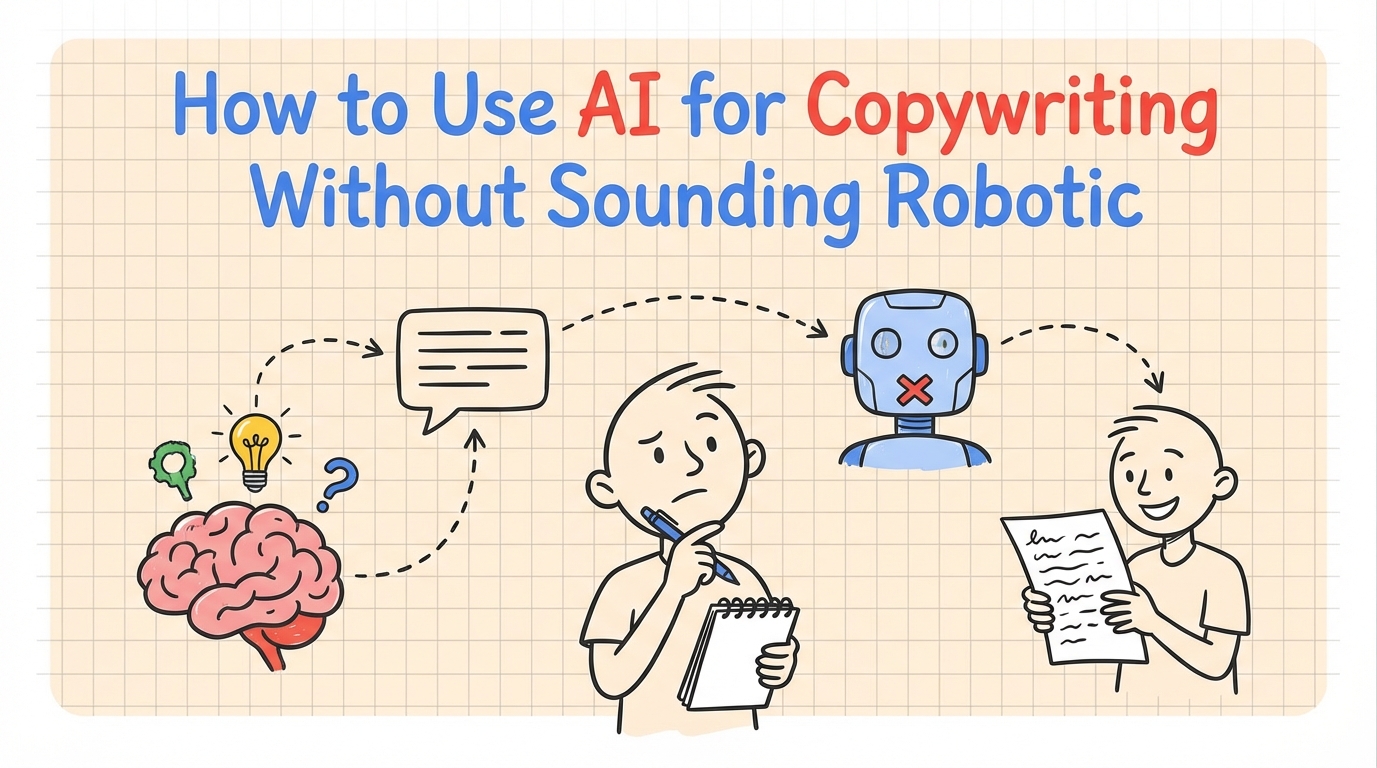
How to Use AI for Copywriting Without Sounding Robotic
Add the right prompting elements and AI produces copy that sounds like a person wrote it. The problem isn't the tool — it's that a generic prompt gets the model's most statistically safe output. This article covers why AI defaults to generic writing and exactly what to add to your prompts to fix it.
By John P. Jochem · · 10 min read
Most people open ChatGPT or Claude, type something like "write a homepage headline for my project management software," and get back:
Streamline your projects. Scale your business.
It's clean. It says nothing. And it could apply to approximately 3,000 other products.
That's not a sign the tool doesn't work. It's a sign the prompt didn't give the model anything to work with. AI copywriting that sounds human isn't a different tool. It's a different approach to the same one you're already using.
Why AI Defaults to Generic Output
When a large language model generates text, it completes patterns. It was trained on billions of words from across the internet and learned that certain phrases appear together constantly in professional writing: "streamline your," "enhance your," "transform your." Those patterns got reinforced repeatedly.
The second layer is RLHF, or reinforcement learning from human feedback. During this training phase, human raters scored outputs, and the model learned to produce what they preferred. Raters consistently preferred writing that felt polished and professional. What that actually rewarded, in practice, was writing that felt safe: familiar structure, conventional phrasing, nothing that would raise an eyebrow.
Researcher Valerio Nastruzzi described this in a February 2026 piece in The Register as "semantic ablation" — the algorithmic erosion of the specific, the precise, and the idiosyncratic in favor of statistically probable blandness. The sharp, distinctive details that make copy land get smoothed away in favor of average.
The practical result: give the model a vague prompt and it gives you the center of its training distribution. That center is bland by design. Your job is to push it off center with constraints and context.
The Patterns That Give It Away
Before fixing the problem, it helps to know what you're looking for. Robotic AI copy has consistent tells.
Filler opener phrases. "As businesses increasingly look to..." or "In a competitive marketplace..." These exist because they're statistically common before actual content. They signal nothing to the reader and waste their first three seconds.
The enthusiasm word bank. Leverage. Unlock. Empower. Harness. Transform. These appear constantly in AI output because they were common in the professional writing the model trained on. They don't persuade anyone. They signal that a human wasn't involved.
Generic audience placeholders. "Your business." "Your team." "Your customers." No specific detail about who this person actually is or what they're dealing with right now.
Bullet point default. Ask for "copy" and you often get a structured list, because lists are the statistically safe format for informational writing. Copy isn't informational writing. It's persuasion with rhythm.
Four Things That Actually Change the Output
1. Assign a specific voice before giving the task
This is the highest-leverage move available, and most people skip it. The model doesn't have a default voice that suits you. It has a default voice that suits no one in particular. Route it away from that default by giving it a writing identity.
Not: "Write like a professional marketer." That's the default. That's the problem.
Instead, try something like "Write in the style of Seth Godin — short declarative sentences, one idea per paragraph, no hedging, ends with a reframe."
If you don't have a name to drop, paste 3 to 5 sentences from copy you already like and say "Match this voice and rhythm." Your own past writing, a competitor you admire, a brand whose tone fits — any of it works.
A real sample to match will always outperform an adjective-based description, because you're giving the model a pattern instead of an instruction to interpret. "Write in the style of Seth Godin..." or "Write like Liquid Death's marketing team — irreverent, deadpan, talks to the customer like they're in on the joke, never takes the product too seriously..." pulls completely different language than no direction at all. You're not describing a mood. You're pointing the model at a recognizable cluster of patterns it already knows.
2. Add writing rules — tell it what not to do
Most prompts tell the model what to create. The ones that produce usable copy also tell it what not to do. Every model has defaults it drifts toward under low constraint. Name the ones you don't want: no em dashes, no "leverage," "unlock," "streamline," or "empower," no sentences that open with "As" or "In today's," keep sentences under 20 words, write in prose not bullet points, and do not open with a question.
You don't need all of these every time. Pick the ones matching what the model keeps defaulting to when you run without constraints. The model doesn't resist these rules. It follows them readily. Most people just never give them.
3. Describe a real audience, not a demographic
Generic prompts get generic copy because the model fills in a generic reader. If you don't say who the reader is, it imagines someone in the middle of all possible readers.
The fix is specificity about the reader's actual situation: not demographics, but what's happening in their life right now that makes this relevant.
Vague: "Write for small business owners."
Specific: "Write for a founder who's been running a 6-person agency for three years, knows they need better processes, but is skeptical of every piece of software that claims to fix it. They've bought three tools in the last year and stopped using all of them within a month."
That specificity changes what the model writes. It can now address a real problem, a real skepticism, a real situation — instead of writing for the imagined median business owner who doesn't actually exist.
4. Work in stages, not one-shot drafts
Asking for a polished final draft in one prompt is the fastest route to generic output. The model doesn't know what "good" means in the context of your brand unless you build that context first.
A three-stage approach produces consistently better results.
Stage 1 is the brief. Give the model your product, audience, the one claim you want to make, and the format. Ask it to summarize what the copy should accomplish before writing anything. Review it. Fix it at this stage, not after you have a full draft.
Stage 2 is the section draft. Write one element at a time: a homepage headline, then the hero subhead, then the intro paragraph — not "write me a homepage." Each piece gets full attention rather than a rush to complete a whole document.
Stage 3 is specific refinement. Not "make it better." Specific: "The headline is too generic. Reference the skeptical three-year founder we described. The subhead sounds corporate. Rewrite it as if you're texting a friend about a product you actually use."
Each stage gives the model more signal. By stage three you're working from something real instead of starting over from a blank prompt.
Before and After: What the Difference Looks Like
Example 1: Short-Form Blog Post Intro (Seth Godin style)
Seth Godin's blog posts run 100 to 200 words: one counterintuitive idea, short declarative sentences, no throat-clearing, ends with a quiet reframe. It's a format where the difference between a vague and a guided prompt shows up immediately. Here is the unconstrained version:
Write a short blog post intro about why most businesses fail at marketing.
Output:
In today's competitive business landscape, effective marketing has become more
important than ever. Many organizations struggle to connect with their target
audience and see the ROI they're looking for. The key to success lies in
understanding your customers and crafting messages that truly resonate...
Generic opener. Vague claim. Could have been written about any topic in any decade.
Now with voice, a specific provable idea, format, and hard constraints:
Write a short blog post intro in the style of Seth Godin. His style: short
declarative sentences, one idea per paragraph, no throat-clearing, no setup.
Ends with a reframe or a quiet challenge — something that makes the reader
question the assumption they walked in with. Never explains the reframe.
Trusts the reader to sit with it.
The idea to argue: most businesses don't have a marketing problem. They have
a "saying the same thing as everyone else" problem. Better distribution won't
fix undifferentiated messaging.
Under 120 words. Prose only, no headers or bullets. No "in today's landscape."
No "more important than ever."
Output:
Most businesses think they need more reach.
More impressions. More clicks. A bigger megaphone.
But a bigger megaphone doesn't help if you're saying the same thing as the
person next to you. It just makes the noise louder.
The problem isn't distribution. The problem is that your message sounds like
everybody else's message. Safe. Predictable. Assembled from the same pile of
industry language that your competitors already picked through.
You don't need a better funnel. You need something worth saying.
And here's the part nobody wants to hear: if you removed your logo from your
marketing, and your competitor's audience couldn't tell the difference —
you don't have marketing. You have wallpaper.
The voice instruction replaced the corporate opener with a direct challenge. The specific idea gave the model a real argument to make, not a topic to describe. The constraints on length and banned phrases blocked the defaults before they could appear.
Example 2: Product Description (Ryan Reynolds voice)
The voice-plus-audience-plus-exclusion-list combination works just as well for product copy as it does for editorial writing. This example also adds one more ingredient: customer language pasted directly into the prompt. Real reviews give the model vocabulary and emotional specificity that no amount of briefing can manufacture. Here is the unconstrained version:
Write a product description for a soy wax candle. Rosemary and lavender scent.
Output:
Indulge your senses with our luxurious rosemary and lavender soy wax candle.
Hand-poured with love, this artisanal blend creates a calming atmosphere perfect
for unwinding after a long day. Let the soothing aroma transform your space into
a personal sanctuary. 60-hour burn time. Cotton wick. $34.
"Hand-poured with love." "Transform your space." "Personal sanctuary." Every phrase the buyer has already scrolled past on forty other candle pages. Nothing here is specific to this scent, this product, or this person.
Now with the voice named, the product grounded in specifics, the audience's actual decision described, the reason this scent is different explained, and the exclusion list doing real work:
Write a product description in the voice of Ryan Reynolds — dry, deadpan,
says the obvious thing everyone's thinking but no one says out loud.
The product is a soy wax candle. Rosemary + lavender scent. 60-hour burn time,
hand-poured in Austin, cotton wick. $34. This is one scent in a lineup — the
description needs to sell this scent specifically, not candles in general.
The person reading this is browsing the candle page deciding between scents.
They want something for the wind-down — after work, weekends, bath time.
They're not looking for sweet or heavy. They want clean and calm without
smelling like a spa lobby or a perfume counter.
Why this scent: rosemary keeps it from being sleepy the way straight lavender
is. The combination smells clean and sharp enough to actually feel like a reset,
not a bedtime candle.
100-150 words. Format: Headline / Body / CTA. The headline should differentiate
this scent, not candles in general. The CTA should feel like the voice, not a
generic "Shop Now."
No "hand-poured with love." No "notes of." No "transform your space."
No "self-care journey." No "artisanal." No exclamation points.
This is a product page, not an ad — inform more than persuade.
Use the specific language and details from these customer reviews:
"I light this after work and my whole apartment smells like a garden within
like 10 minutes. It's the only candle I've had that actually fills the room."
"My boyfriend doesn't notice anything ever and he walked in and asked what
smelled so good. That says a lot."
"On my third one. I used to rotate scents but this is the one I keep coming
back to. Not sweet, not perfumey, just really clean and relaxing."
Output:
Rosemary Lavender: The One You Stop Rotating For
Lavender calms you down. Rosemary makes sure you're still awake to enjoy it.
Together they smell like a garden that somehow ended up in your apartment,
which is exactly what happens about ten minutes after you light this thing.
It fills the room. The whole room. Not in a "someone sprayed something" way.
In a "something just smells really good and I can't figure out what" way.
Your boyfriend will notice. And he doesn't notice anything.
Soy wax. Cotton wick. Hand-poured in Austin. 60-hour burn time, which means
roughly two months of post-work wind-downs before you order your third one.
Because you will order a third one. People do.
Clean, sharp, calm. Not sweet, not perfumey, not trying to put you to sleep.
$34. You know this is the one.
The voice reference gave the model a register — dry, confident, slightly self-aware — that no amount of adjective-based description would have landed. The audience detail moved the copy away from generic "relaxation" territory and toward the specific decision this person is actually making: not sweet, not heavy, not another spa scent. The customer review language surfaced the "fills the room" and "not perfumey" details directly. And the exclusion list cleared out every default candle-description phrase before it could appear.
That last point is worth naming: the output didn't come from the model being clever. It came from giving it enough constraint that clever was the only thing left.
What to Take Away
The robotic quality in AI copy comes from a specific set of causes: training optimized for safe, polished output, statistical default patterns, and prompts that give the model nothing to push against.
The fix is just as specific. Name a voice. Give the model your actual reader in one concrete sentence. State what the output must not sound like. Break the task into stages instead of asking for a finished draft in one shot.
None of this requires becoming a prompt engineer. It's the same thinking that goes into a good creative brief: the clarity you bring to the input determines the quality of what comes out. The difference is that with AI, that brief goes directly into the chat instead of to an agency.
Start with your next piece of copy. Pick a brand voice you respect, describe your product, your reader's situation (not demographics), add three rules for what the output shouldn't say, and see what comes back. That's the whole method. If you want ready-to-use prompts that apply these principles to specific formats, check out our guides on AI prompts for product descriptions, ad copy, and landing page copy.
Frequently Asked Questions
Does the model matter, or is this approach the same across Claude, ChatGPT, and Gemini?
The approach is the same across models, but the defaults differ and you will likely see noticeable differences. Start with whichever you already have access to. The principles here improve output on all of them.
How do I give the model my brand voice if I don't have existing copy to paste?
Start by describing three things your brand is not: "Don't sound like a consulting firm, don't sound like a startup in pitch mode, don't use corporate jargon." Negative constraints are often easier to define than positive ones, and they're surprisingly effective at ruling out the defaults. Once you have a few pieces of AI-generated copy you like, use those as reference for the next prompt.
What's the biggest mistake people make when prompting for copy?
Not giving the model enough context to make the right distinctions. The model doesn't know your product is different from the fifty similar ones it's processed, that your audience is skeptical rather than curious, or that "professional" means something specific in your industry versus someone else's. Without those details, it fills the gaps with averages. The output looks fine and says nothing. Context is what separates a prompt from a brief, and a brief is what actually produces usable copy.
Why does AI keep using phrases like "leverage," "unlock," and "in today's landscape" even when I don't want them?
These phrases are heavily represented in the professional writing the model trained on. Without a rule telling it not to use them, they're statistically probable outputs for anything that needs to sound professional. The fix is explicit: add "no leverage, no unlock, no 'in today's [anything]'" to your writing rules. The model follows the rule as soon as you state it.
Does this work for long-form content, or just short copy like headlines and emails?
It works for both, but long-form benefits most from the staged approach. For a blog post or landing page, write the brief first, then draft section by section, then refine. For short copy like headlines, subject lines, and CTAs, the full prompt in one shot usually gets you to a usable first draft with one round of refinement.
Related Articles
Tags
- ai copywriting
- ai prompting for copy
- copywriting prompts
- ai writing tips
- brand voice ai
- prompt engineering
- copywriting
- AI tools
Frequently Asked Questions
Does the model matter, or is this approach the same across Claude, ChatGPT, and Gemini?
The approach is the same across models, but the defaults differ and you will likely see noticeable differences. Start with whichever you already have access to. The principles here improve output on all of them.
How do I give the model my brand voice if I don't have existing copy to paste?
Start by describing three things your brand is not: 'Don't sound like a consulting firm, don't sound like a startup in pitch mode, don't use corporate jargon.' Negative constraints are often easier to define than positive ones, and they're surprisingly effective at ruling out the defaults.
What's the biggest mistake people make when prompting for copy?
Not giving the model enough context to make the right distinctions. The model doesn't know your product is different from the fifty similar ones it's processed. Without those details, it fills the gaps with averages. Context is what separates a prompt from a brief.
Why does AI keep using phrases like 'leverage,' 'unlock,' and 'in today's landscape'?
These phrases are heavily represented in the professional writing the model trained on. Without a rule telling it not to use them, they're statistically probable outputs. The fix is explicit: add them to your writing rules and the model follows the rule as soon as you state it.
Does this work for long-form content, or just short copy like headlines and emails?
It works for both, but long-form benefits most from the staged approach. For a blog post or landing page, write the brief first, then draft section by section, then refine. For short copy, the full prompt in one shot usually gets you to a usable first draft.