AI Trends
ChatGPT Ads: How They Work, What They Cost, and Whether They're Worth It (2026)
ChatGPT ads are sponsored cards that appear below ChatGPT's answers, matched to the conversation itself. OpenAI's self-serve Ads Manager opened the platform to businesses of any size — here's how the format works, what it costs, how it compares to Google and Meta, and how to decide if it's worth testing.
By John P. Jochem · · 8 min read
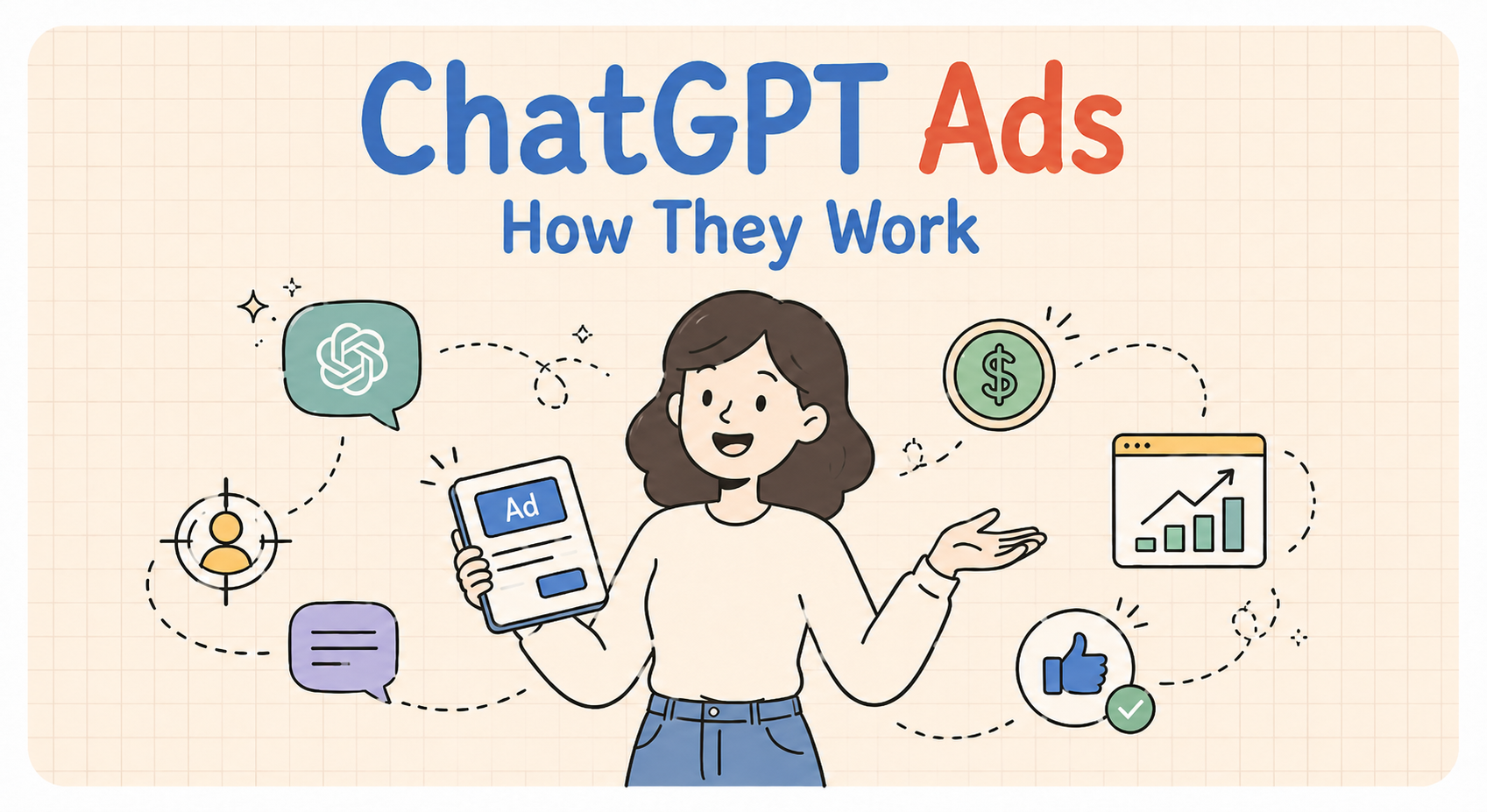
ChatGPT ads are sponsored cards that appear below ChatGPT's answers, matched to whatever the person is actually working through in the conversation. OpenAI recently opened the platform to businesses of any size through a self-serve Ads Manager, so you no longer need an enterprise budget to run them. They're worth testing if your product is something people research, compare, or plan around, and a weak fit if it mostly sells on impulse.
The rest of this guide breaks down how the format works, how it differs from Google and Meta, what it costs, and how to decide whether your business should test ChatGPT advertising.
What are ChatGPT ads?
ChatGPT ads are small sponsored units that appear at the bottom of a ChatGPT response, after the assistant has finished answering. They carry a "Sponsored" label and sit in their own card, separate from the answer itself. The ad is never written into the response.
Each ad unit holds a fixed set of elements:
- Your business name
- Your logo
- A short title
- A line of ad copy
- An image
- A landing page link
The ads appear for people on ChatGPT's free and lower-cost plans, not on the higher paid tiers. They don't show for users ChatGPT believes are under 18, and they don't appear near sensitive subjects like health, mental health, or politics. Availability and rules shift as the platform expands, so the Ads Manager dashboard is the place to confirm what's currently live.
How do ChatGPT ads work?
ChatGPT ads are matched to the conversation, not to a profile built from someone's browsing history. The system reads what the person is discussing and surfaces an ad when there's a relevant product for that topic. Someone working through a meal-prep routine might see a meal-kit service. Someone comparing project tools might see one of those tools.
This is contextual advertising rather than audience targeting. There are no demographic filters, custom audiences, or lookalikes. You give the system context hints about the kinds of conversations where your product fits, and it decides where your ad belongs. Those hints guide the match, but they don't guarantee placement in any specific conversation.
The signal is richer than a search keyword. A search for "best project management tool" tells an advertiser the topic. A ChatGPT conversation where someone explains they're a freelancer juggling five clients, already tried a tool that felt too complex, and need something simpler that also handles invoicing tells the advertiser the topic, the situation, the history, the objection, and the requirement.
How are ChatGPT ads different from Google and Meta ads?
The core difference is the signal each platform reads, which changes what the ad has to do.
| Platform | What it reads | The person's mindset | What the ad has to do |
|---|---|---|---|
| The keyword they typed | Searching for something specific | Match the search clearly | |
| Meta | Their interests and behavior | Scrolling, not asking for help | Stop the scroll |
| ChatGPT | The conversation they're having | Working through a problem or decision | Feel like the next useful step |
Because the person reading a ChatGPT ad just received help with something specific, an ad copied from another platform tends to land awkwardly. A scroll-stopping social ad feels out of place under a thoughtful answer, and a thin keyword-matched headline feels like it's missing something. The ads that work read like a logical next step for someone who was just helped.
If you want a deeper breakdown of how to write copy that fits the moment instead of the platform default, our AI prompts for ad copy that converts guide is the next read.
How much do ChatGPT ads cost?
ChatGPT ads use two pricing models: cost per click (CPC) and cost per thousand impressions (CPM). CPC suits campaigns built around sending people to a landing page, and CPM suits campaigns focused on exposure or awareness.
Current starting guidance from the platform is a maximum bid of roughly $3 to $5 per click for CPC campaigns and a default maximum of about $60 CPM for reach campaigns. Bid guidance changes as the platform matures, so treat these as starting points rather than fixed rates. The practical takeaway matters more than the exact numbers: this is not a channel where vague creative gets rescued by volume, so the math needs to make sense before you scale spend.
Should your business advertise on ChatGPT?
ChatGPT ads work best when your product solves a problem people already bring to ChatGPT in a conversation. The clearer the use case, the easier the system can place your ad in front of the right person.
Good fits usually share a few traits:
- People research or compare options before buying
- There's a real task, workflow, or decision attached to the product
- The use case is easy to describe in one plain sentence
- The buyer is often mid-problem, not browsing for fun
Weaker fits tend to look like this:
- The product is bought on impulse with little research
- The value is hard to explain without a long setup
- There's no obvious moment where someone would ask ChatGPT about it
A quick test: if you can picture the exact question a customer would type into ChatGPT right before your product becomes useful, it's probably worth testing. If you can't, the contextual advantage that makes this channel interesting isn't really there for you.
How do you write a ChatGPT ad that fits?
Strong ChatGPT ads name the task and the outcome instead of describing the company. Generic copy fails because it talks about the brand rather than the moment the reader is in. The fix is to start from what the person is doing and point them one step further.
A few examples of the shift:
- A design tool moves from "create better visuals" to "turn rough product photos into clean, listing-ready images"
- A bookkeeping tool moves from "manage your finances with ease" to "clean up invoices, expenses, and tax prep in one place"
- A scheduling tool moves from "save time and stay organized" to "turn messy client follow-ups into a clear weekly schedule"
The pattern is the same each time: name the task, name the outcome, cut the vague hype. The landing page then has to keep that same promise, because a click that lands on a generic homepage usually goes nowhere.
How to get started with ChatGPT ads
OpenAI runs ChatGPT advertising through a self-serve Ads Manager, similar in shape to Google Ads or Meta Ads Manager. Setting up an account is the easy part. You create an advertiser account, add billing, upload creative, and launch. The part that decides whether a campaign works is the strategy underneath it: mapping the conversations where your product belongs, structuring ad groups around those moments, writing context hints that guide the match, and measuring past the click instead of celebrating raw clicks.
That full playbook, from account setup through reading your results in layers, is exactly what we walk through step by step inside the MarketPrompter course. If you're planning to test ChatGPT ads for real, that's the place to start.
Related Articles
Tags
- chatgpt ads
- chatgpt advertising
- openai ads
- chatgpt ads manager
- contextual advertising
- ai ads
- paid media
- AI tools
Frequently Asked Questions
Does ChatGPT have ads?
Yes. ChatGPT now shows sponsored cards below answers for users on the free and lower-cost plans. They're labeled 'Sponsored,' sit in their own card separate from the response, and don't appear on the highest paid tiers or near sensitive topics like health and politics.
Are ads coming to ChatGPT, or are they already live?
They're live. OpenAI rolled out a self-serve ChatGPT Ads Manager that lets businesses of any size create campaigns, set CPC or CPM bids, and target by conversational context rather than by audience profile.
What do ChatGPT ads look like?
Each ad is a single card under the answer with your business name, logo, a short title, one line of ad copy, an image, and a landing page link. The ad is never written into the response itself — it always sits in its own clearly-labeled sponsored unit.
How do you run ads on ChatGPT?
You create an account in the ChatGPT Ads Manager, add billing, upload your creative (logo, image, title, copy, landing page), write context hints describing the conversations where your product fits, set a CPC or CPM bid, and launch. The system handles the contextual matching.
How much do ChatGPT ads cost?
Starting guidance is roughly $3 to $5 maximum bid per click for CPC campaigns and around $60 CPM for reach campaigns. Bid floors and guidance shift as the platform matures, so confirm current rates in the Ads Manager before scaling spend.
How are ChatGPT ads different from Google ads?
Google ads match a keyword the person typed. ChatGPT ads match the conversation the person is having — which includes the topic, situation, history, and objection. The intent signal is richer, but it means ad copy written for Google search rarely transfers cleanly.
Are ChatGPT ads worth it for a small business?
They're worth testing if your product solves a problem people already bring to ChatGPT in a conversation — anything researched, compared, or planned around. They're a weak fit for impulse purchases or products with no obvious moment someone would ask ChatGPT about them.